In America’s dairyland, it’s no wonder that UW–Madison spinoff Galasys has made a marketable product out of dairy waste.
The company specializes in deriving tagatose, a low-calorie sweetener, from lactose, the sugar found in cow’s milk. Lactose itself has little value—it is often removed from milk due to lactose intolerances, resulting in a significant waste stream. Galasys not only capitalizes on discarded lactose by creating a high-value product with health benefits, but also reduces the environmental impacts of existing waste.
Galasys is a product of over nine years of research and funding, including through the USDA and Wisconsin Alumni Research Foundation (WARF). Co-founders George Huber (Richard L. Antoine Professor of Chemical and Biological Engineering), his former undergraduate student Jarryd Featherman (research specialist and serial entrepreneur in the Department of Chemical and Biological Engineering), and Scott A. Rankin (Professor and Chair of Food Science) established the company in 2023. Featherman was a top student who impressed Huber, inspiring the professor to propose opening a company together. His instincts were correct: Galasys won first place in the Advanced Manufacturing category of the 2025 Wisconsin Governor’s Business Plan Contest, and Featherman is set to become Galasys’s first full-time employee in the coming weeks.
The Technology Entrepreneurship Office (TEO) has played a key role in Galasys’s growth. Dr. Shelley Shi, Specialist for Translational Research (previously Scientist II), has worked with Huber and Featherman on technical transition over the last three years. In her role as co-PI and advisor, Shi led efforts in core technology and methodology development, proposal preparation, regulatory compliance for food ingredients, and fundraising—gaining over $1M in research funding. By 2025, the company secured a USDA Small Business Innovation Research grant to spin out from UW–Madison and begin scaling up at the Center for Dairy Research and Babcock Dairy Plant. Galasys has also received entrepreneurial support from D2P on campus, as well as the UW system’s Center for Technology Commercialization and Small Business Development Center.
We asked Huber about his experience working in food science development, the academic future of innovation, and how—if you assemble a great team—it’s never too early to begin your entrepreneurial journey.
1. Tell me more about the story of Galasys. What is the science behind the company, and why that name?
George Huber: With Galasys, we’re making a rare low-calorie sugar called tagatose. Tagatose has a similar sweetness to sucrose, but one third the calories. It acts just like normal sugar in your food. We actually did a big taste test in Babcock Hall here on campus. We made chocolate milk with table sugar, or sucrose, and we made chocolate milk with tagatose, and they tasted exactly the same.
The key thing is we make it from lactose, the sugar that’s found in all cow’s milk. Lactose is not a very valuable sugar. There’s lots of people who are lactose intolerant, so in a lot of dairy products, you take it out. Same thing when making whey protein—the protein is the valuable component, the lactose isn’t. Because of this, there’s a lot of lactose going to wastewater treatment plants or being dumped on farmer fields. It isn’t even worth the cost of recovering it.
Lactose is a disaccharide, or two sugars together. At Galasys, we have two chemical steps. First, we hydrolyze lactose to glucose and galactose, the two monosaccharides. Then we can isomerize the galactose and separate the tagatose out. We use a technology called Simulated Moving Bed to manufacture the tagatose. The name Galasys comes from galactose.
Our key advantage is that we have a patented technology to make tagatose from dairy waste. We have a $120,000 pilot plant in Babcock Hall where we’re making kilogram quantities of glucose and galactose. In the future, we hope to go commercial and then start making ton quantities of tagatose, partnering with companies who have large amounts of lactose dairy waste.
2. How did you and Jarryd Featherman, your former student and co-founder, take your science (tagatose) from the lab to the marketplace?
GH: It’s never a linear process. There’s always ups and downs. We had funding, and we first tried to commercialize just selling glucose and galactose syrup (GGS), but we had to compete with high fructose corn syrup—GGS would sell at the same price. High fructose corn syrup plants are huge, very efficient, and derived from corn, our number one plant that we produce. It’s hard to be competitive against that.
Then we said, what could we make that’s higher value and unique? We’re a big dairy state, so all those cows make lactose. There’s lots of lactose waste streams. And that’s where we started working on tagatose. It even has some health benefits.
Jarryd is really talented. He’s done a great job putting the business team together and developing the technology.
3. What role did TEO play in moving your research from campus to company?
GH: Dr. Shelley Shi has been super valuable in all of this. She helped us write grants to get funding. I’m a chemical engineer, but she’s a food scientist by training, so she helped us look into the regulatory approval you need for tagatose. She helped us analyze some of the food properties of tagatose, helped us do the taste test study with chocolate milk. She’s been a great asset and contributor to all of this.
4. How is Galasys utilizing collaboration to accelerate tagatose commercialization?
GH: As a small company, you need to know what you’re good at and then bring in the right partners and the right skill sets. You just don’t have the resources of a large company. Our key partner is a company called Orochem. One of the owners, Anil Oroskar, is a UW alumnus who graduated in 1981 with his PhD in chemical engineering. He was one of the lead developers of the Simulated Moving Bed technology to make high fructose corn syrup. That technology is critical, because it separates out the tagatose.
5. What would you tell other undergraduate founders or advisees if they want to follow the same path as Jarryd?
GH: Are you sure you want to do it? That’s the first question. Galasys is the third company I’ve co-founded. It’s a great experience—you learn a lot, you grow a lot, you meet great people. Make sure you put a good team around yourself so you’re successful. With any company, you win because it’s a team effort, so you need to know how to work with other people. Be open to listening to them.
You have to be very committed to your idea, but it’s more than that. Also make sure you understand the market. You need to know how to get feedback. And you have to be lucky—there has to be the right time and right place to build a company and a technology. Technology innovation is going to come from universities. Corporations have shut down a lot of their research and development labs. Most companies want to run a business that generates a lot of cash and returns revenue for that next quarter, so the innovation has to come from universities. We need more entrepreneurs that can take technologies from academic labs and build businesses around them.
• • •
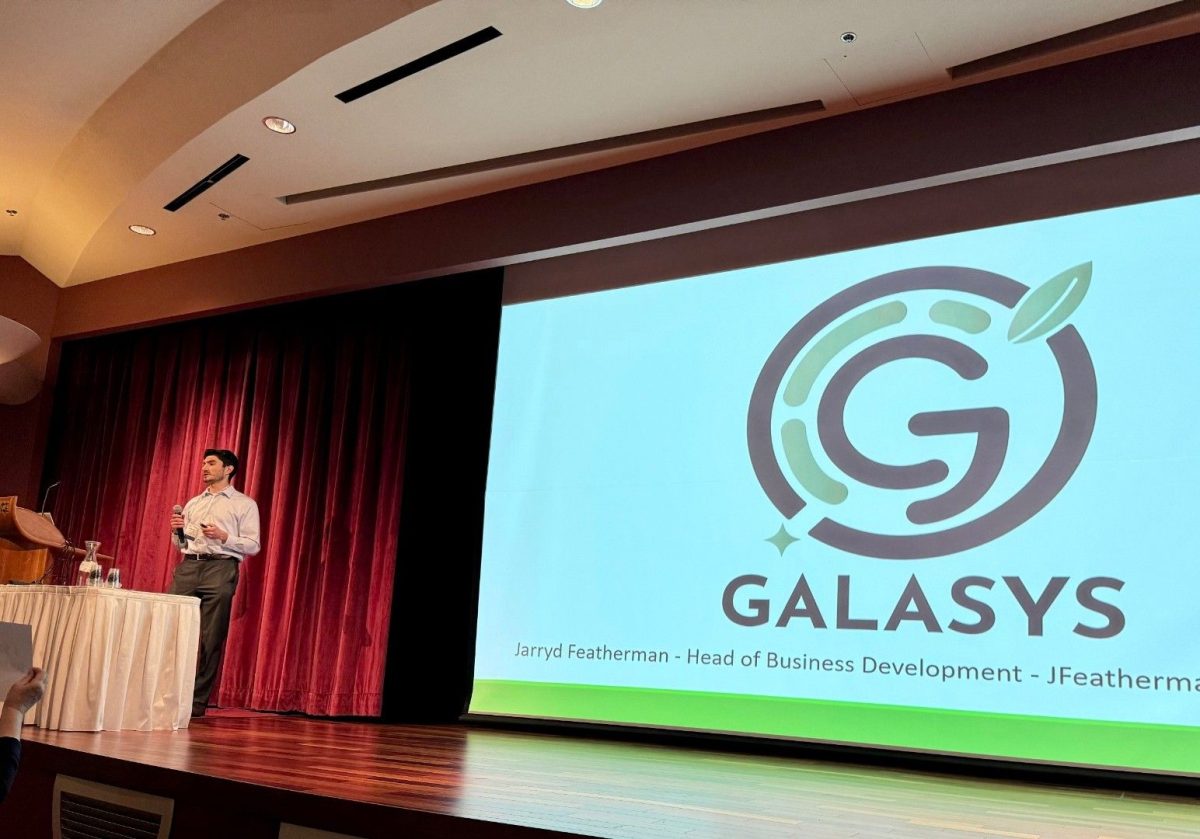
Feature image: Jarryd Featherman, co-founder of Galasys, gives the award acceptance speech for the 2025 Wisconsin Governor’s Business Plan Contest.
Written by: Bri Meyer