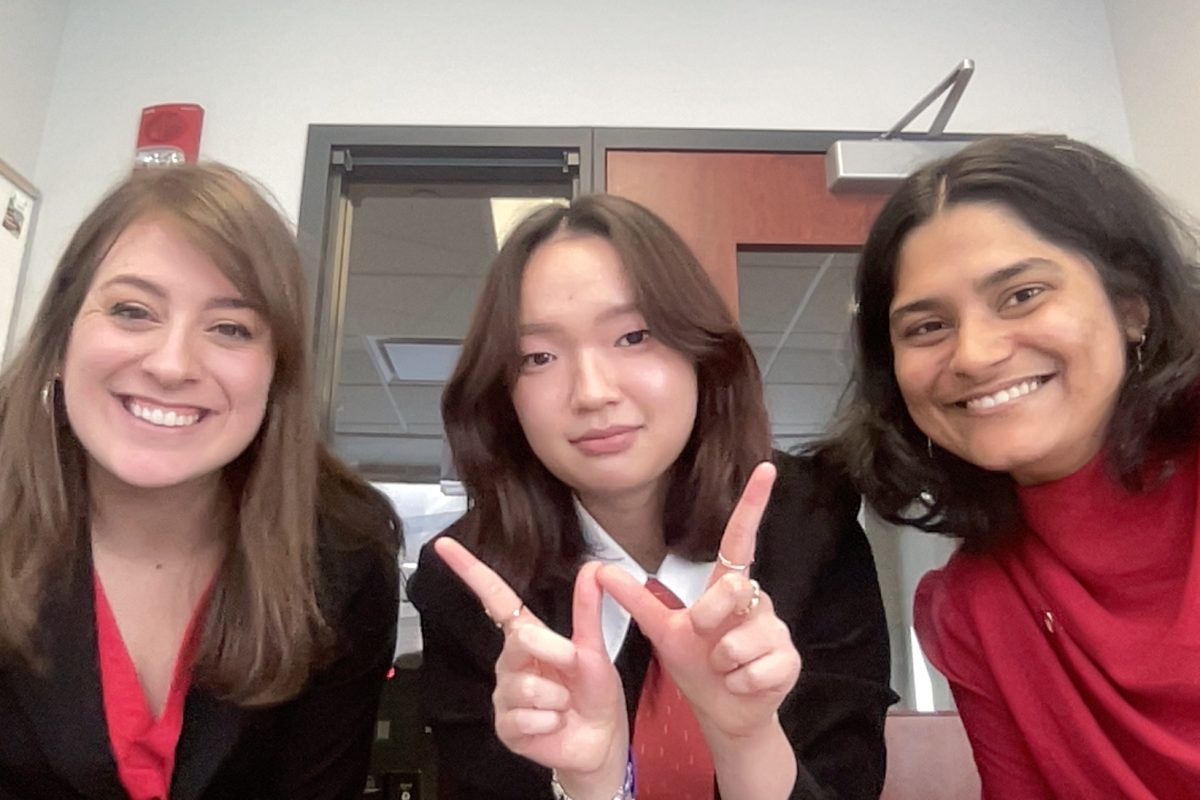
In its second annual Analytics Case Competition, the National Football League Players Association (NFLPA) offered $30,000 in prizes to undergraduate and graduate students to address the following challenge: how do the cumulative effects of workload throughout the season impact key metrics such as player performance, injury risk, earnings, or team wins and losses?
Wisconsin School of Business MBA Student Ambassador and TEO student assistant Deeksha Singh Vijay Singh‘s team was selected not only as one of five finalists, but was announced as the graduate winner on February 5, 2026.
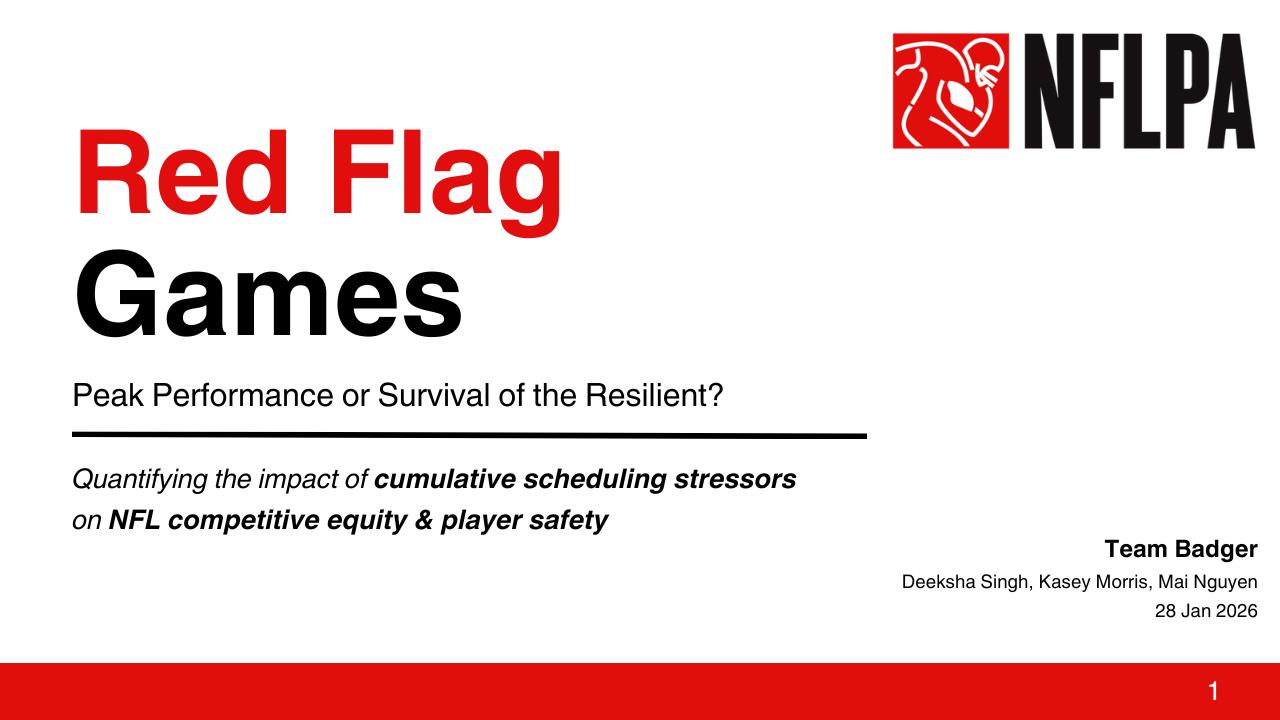
Potential focus areas were broad, including topics like addition of a second bye, compressed game schedule, field surface type, international travel, length of season, player workload and performance, position of the bye week, and relationship between earnings and playtime. Singh and her team, Kasey Morris and Mai Nguyen, won $12,000 analyzing red flag games (short rest of less than six days combined with travel through more than two timezones) and their effect on stress and player performance.
We asked Singh about the competition, her team’s strategy, and her best advice for finding the conditions you need to thrive—in entrepreneurship, in career, and in life.
How did you find this competition and why did you choose to compete?
Before this competition, I did not know anything about American football, because for me, football is soccer—and the funny thing is, I don’t even know a lot about that! I’m a first year MBA student and I have a goal of participating in ten competitions over this academic year. From my undergrad days, everything I know about business and entrepreneurship stemmed from doing these competitions. It’s a discrete, high-pressure period with a team. It’s project-based and everything needs to be well thought out.
I wanted to keep putting myself in situations and seeing how I managed to get out of them. This NFLPA one wasn’t really advertised, but my teammate Mai is an MS Business Analytics student and she thought it was relevant for her specifically. I wanted to do more analysis. We got Kasey from the finance specialization in the MBA program and the rest was history.
How did you approach your topic of red flag games? How did you arrive at that focus area with your team?
The original prompt was open-ended—which to us meant we didn’t know where to start, so we started researching the problem space more. I spoke to a footballer on the UW–Madison team who is also an MBA student to try to get an understanding of his pain points. He helped provide a lot of initial direction about short rest, because then you don’t have time to recover. We took that as a data point and then we triangulated it against the current industry trends.
We created a whiteboard to understand how travel and short rest affect performance and injury risk on the individual player level. However, two weeks into our work, my analysis showed that short rest actually improves performance and reduces risk of injury. I thought I had to be doing something wrong. But my work was validated by the industry. It made sense—it was just bad news for us. We were very despondent, but I tried to rally the team—because this is where the best innovation comes from.
I then noticed that there was not enough data for certain teams and players. Doesn’t this mean that certain players are just not encountering certain risk conditions? There were different types of risks that each position group was absorbing. Let’s look at frequency, exposure, and fairness at the team level, the position group level, and the player level. I started mapping it out in a matrix.
We found out that West Coast teams are unfairly disadvantaged. They are encountering a red flag game four times more than the league average, while East Coast teams are encountering it zero percent of the time. That’s not fair. And whenever they were exposed, their performance degraded quite significantly compared to the baseline.
Now, how do we put it in like a narrative that has impact? I think the reason we differentiated ourselves as a team and as a project was because we created a new metric, and we were experts in our insight and our solution, and that made it applicable to the NFL Players union. Our analysis could be scaled up, and we had an answer prepared for any question.
How did your involvement with TEO and your School of Business training prepare you for this opportunity?
The road would not have been as clear or as easy or as supported if I didn’t have either of those two support networks. We had to prepare a 45-minute presentation for stakeholders, and I didn’t want them to be nodding off—I wanted them to be nodding along. In the Wisconsin School of Business, I reached out to Anita Mukherjee. She had me come to her professional MBA class to present. Douglas McLeod and Sameer Deshpande also gave us their thoughts on our work. That feedback was invaluable, not only on a personal and professional level, but also in that this is how the support system should be. And that’s to say nothing of the silent support from all the members of my MBA cohort and my professors.
TEO was also a great support system. In my student assistant role, I’m working on the NSF I-Corps program. One of the co-foundations is customer discovery. I made sure I did my customer and stakeholder discovery in this competition. We reached out to last year’s winners and asked them what kind of questions do they ask in Round 2. We had not even gotten through Round 1, but it’s good to be prepared. I-Corps is also a great program because it’s not in a silo. It exists in a larger ecosystem—there are a lot of different alternative paths you can take from the program. You have access to a large mentor network, which I took advantage of. I mapped out my solution space and looked at support system allies I could leverage to reach my goals. I think every person going into NSF I-Corps should also be thinking, how can NSF I-Corps or TEO help me get to where I want to go next?
How did it feel when you were announced as a finalist and then as a winner?
For Round 1, my team was across multiple time zones—we were in a red flag game ourselves! For Round 2, I was in class. I had just received a job offer for my summer internship, which I sent to my family group chat, and everyone was congratulating me. Then ten minutes later, I refreshed my email and got the NFL announcement. I was vibrating, and the class was not even close to being done. My teammates Casey and Mai were also in class, and no one was responding to my texts because they’re good students, unlike me. After class I apologized to the professor and ran through the Wisconsin School of Business second floor to find my teammates so I could high-five them. And then we went to hotpot.
The quote on your bio says, “Find the conditions you need to thrive.” How did you find those conditions for yourself and what is your best advice for other entrepreneurs on how to find theirs?
In computer science, we often say that certain systems are optimized for the average use case. That makes sense for a lot of systems. However, when it comes to your professional trajectory, your decision making, and your life, you can’t be optimizing for the average use case. General advice won’t necessarily apply to you, the stage you are in your life, and what you need to do to get to where you want to go next.
When I started the MBA as an international student, I knew that I didn’t want to do the same things as everyone else because I didn’t want what everyone else was getting. I wanted something that made sense for me. I needed access to certain networks, mentorship, and practice, which I could get through competitions. I know what my gaps are and how I can leverage my strengths to make up for them. It might not make sense for your use case, but it makes sense for mine. I’m okay with making sacrifices to hit my goal and because I’m able to do it ruthlessly and with precision. I’m not sitting at home stressing about things outside my control—I’m keeping myself busy and showing my work.
• • •
Feature image: Winning NFLPA Case Competition team Kasey Morris, Mai Nguyen, and Deeksha Singh.
Written by: Bri Meyer