The National Science Foundation (NSF) I-Corps™ Teams program is an immersive, innovative program that facilitates the transformation of invention all the way to impact. This seven-week experiential training program prepares scientists and engineers to extend their focus beyond the university laboratory—accelerating the economic and societal benefits of NSF-funded and other basic research projects that are ready to move toward commercialization.
Widely recognized as an effective training program in the U.S. and internationally, I-Corps addresses four urgent national needs:
- Training an entrepreneurial workforce
- Translating technologies
- Enabling positive economic impact
- Nurturing an innovation ecosystem
Research indicates that the primary reason startups fail is the development of products that lack market demand. I-Corps helps entrepreneurs avoid pitfalls by identifying the problem that customers need to solve. Through this program, participants have the opportunity to network with experienced industry mentors, build a solid foundation for their venture, and enhance their credibility for future funding opportunities. Additionally, completing the local or regional program is the most straightforward path to applying for the I-Corps Team award, which helps cover expenses related to customer discovery up to $50,000.
The UW–Madison local I-Corps program prepares teams to have the skillset and eligibility for success in the regional or national I-Corps Teams program. This free six-week, non-credit virtual workshop uses evidence-based strategies for achieving entrepreneurial success and is open to research faculty, staff, and students at any higher education institution.
The 2025 cohort of UW-Madison National I-Corps teams comprised a diverse group of researchers, each with a unique project aimed at addressing pressing societal challenges. Here, we meet the teams and learn more about their groundbreaking work.
Statistical Framework for Language Model Outputs
This project translates a new method for validating artificial intelligence (AI) outputs, helping industries adopt trustworthy and reliable AI technologies. The solution generates calibrated confidence scores, indicating when decision-makers can rely on AI outputs. This solution seeks to address how to ensure AI produces trustworthy responses when used in industry applications, making it safer and more practical to use AI systems across different industries and when time is critical—such as healthcare and finance.

Entrepreneurial Lead: Auden Krauska

Technical Lead: Karl Rohe
Industry Mentor: Ray Mendez
How it works:
- Couples experiential learning with first-hand investigation
- Utilizes an advanced statistical framework for validating Large Language Models outputs
- Individualizes analysis patterns to each output, which improves accuracy
Soil Electrochemical Sensing
This project is advancing agricultural sensors which are capable of directly measuring plant-available nitrate at the plant root zone in real-time throughout the growing season. This ability allows real-time decisions to be made regarding fertilization rates, including using spatially and temporally varying rates.

Entrepreneurial Lead: Kuan-Yu Chen

Technical Lead: Joseph Andrews
How it works:
- Electrochemical, in-situ sensors capable of operating in soil environments
- Sensors use a nanoporous hydrophilic membrane that filters out soil particulates and minimizes interference from soil components
Non-invasive Cell Imaging
This non-invasive imaging solution is designed to improve how therapeutic cells are evaluated in biomedical research. Cell therapies are becoming a critical tool in the treatment of diseases such as cancer, but current evaluation methods are slow, costly, invasive, and incomplete. With this non-invasive technology, researchers can assess behavior of therapeutic cells inside the body over time—critical for advancements in healthcare and public health.

Entrepreneurial Lead: Victor Fernandes

Technical Lead: Reinier Hernandez
Industry Mentor: Rafael Diaz
How it works:
- Radiolabeling platform enables direct, quantitative imaging of living therapeutic cells
- Blend of chemical oxidation, modified metal-binding agent, and positron-emitting isotope means labeled cells maintain viability and function over time
Powder Spreadability Testing
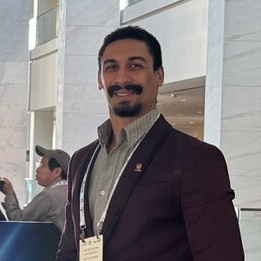
Entrepreneurial Lead: Luis Izet Escaño Vólquez

Technical Lead: Lianyi Chen
Industry Mentor: Xiujuan Jane Zhang
This project pioneers advancements in metal 3D printing through an accurate and precise quality control testing device. Powder-based additive manufacturing depends on the quality of powders that feed into the AM machine. The testing device ensures safety and repeatability in industries that require precision, such as aerospace, medical, and automotive. Read more about the innovation in more detail here.
How it works:
- Assesses metal powders at a detailed, particle-by-particle scale
- Qualification happens under real manufacturing conditions rather than in a thin layer, saving time and money
Chronic Pain Diagnostics

Technical Lead: ShinYe Kim
This digital tool can help better diagnose chronic pain, which affects over 100 million adults in the United States and contributes to an estimated $560–$635 billion annually in lost productivity and healthcare costs. Such advancements can change the game in many ways, but particularly in more accurately communicating pain, reducing misdiagnosis, and preventing opioid dependence or addiction.
How it works:
- A digital phenotyping platform combines linguistic and metabolic analysis with machine learning algorithms to identify patterns in chronic pain expression
- The platform provides real-time, individualized insights that can better treat patients—both in short- and long-term care